



If you use this sentence pattern, I’ll know immediately that you’re using AI:
“It’s not [this], it’s [that].”
That’s called Negative parallelism.
Forget it. Ban it. Remove it from your vocabulary entirely. Every large language model (LLM) today writes this way, even cramming it into the same response multiple times.
Reports have tracked the use of this structure in Fortune 500 companies’ reports: 50 times in 2023, more than 200 times in 2025, and as of now (May 2026), this trend has increased fourfold in just 2 years (!!!). Even this month’s press releases from leading corporations such as Microsoft, McKinsey, Cisco, and Accenture are riddled with it.
The fix is incredibly simple:
- Create a file called
**anti-ai-writing-style.md**(Anti-AI Writing Style). - This is the only file you need to upload to your Claude Cowork folder.
- It also works perfectly with any other AI (such as ChatGPT or Gemini) to edit your writing and “wash away” its robotic feel.
I’ll share this file at the end of the article. Here’s how to set it up in 3 minutes:
1. How it works in practice
I prefer using Claude Cowork for this, but ChatGPT Project works very well too.
Here’s how it works:
- Claude Cowork works with folders. The rule is that it must read the rules file first.
- Inside my folder, there is always a file that forces the AI to audit its own writing against the “anti-AI writing style.”
- You’ll see Claude automatically delete and change wording to make sure it never uses negative parallelism again.
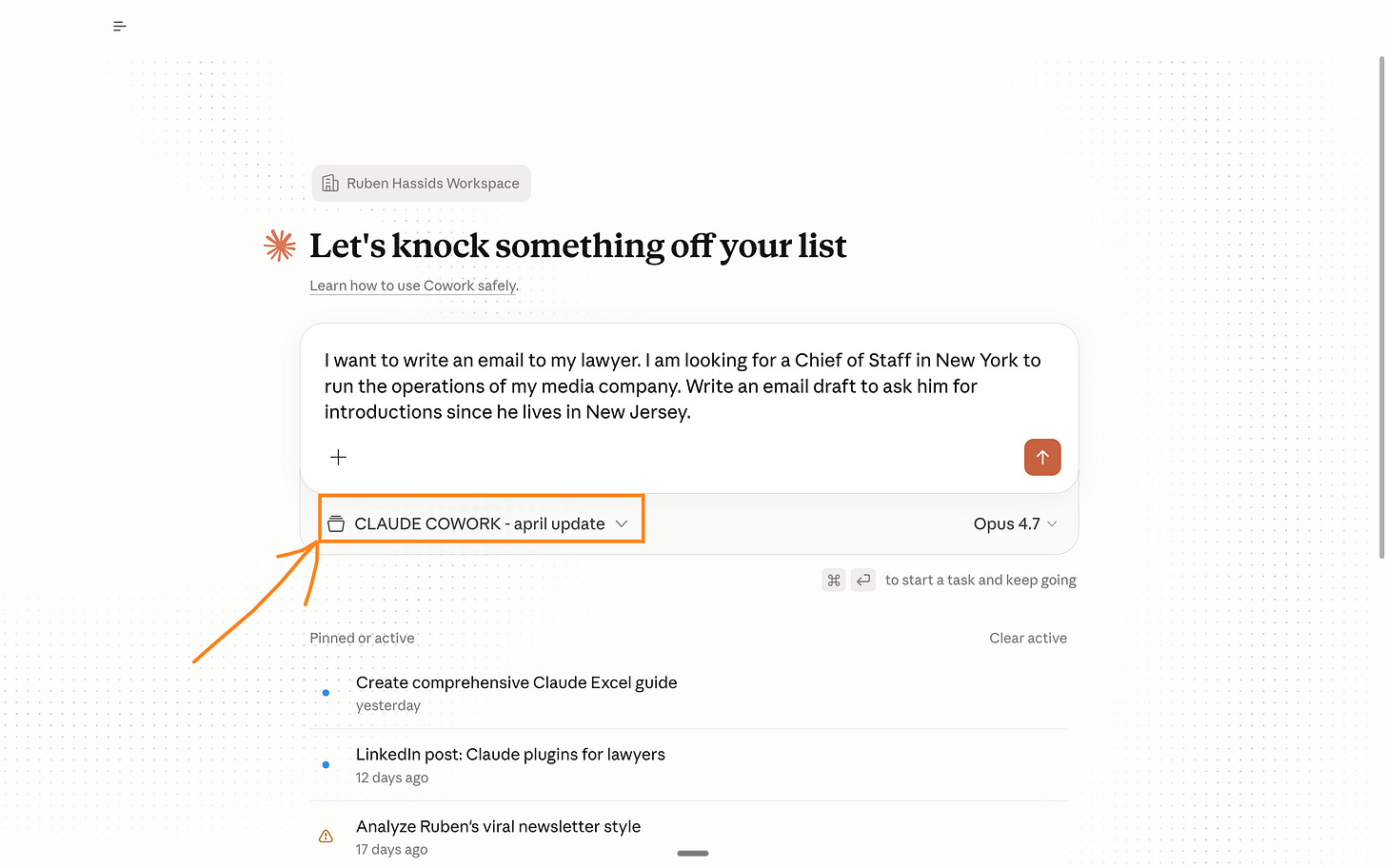
(I point the AI to the “Claude Cowork” working folder)

(Before typing its response, Claude has to read my anti-ai-writing-style.md file)
Then I ask it to write a long LinkedIn post. If I spot AI-style writing, I simply type the instruction: “Audit it against the anti-ai-writing-style.md” (Review this text against the anti-ai-writing-style file).
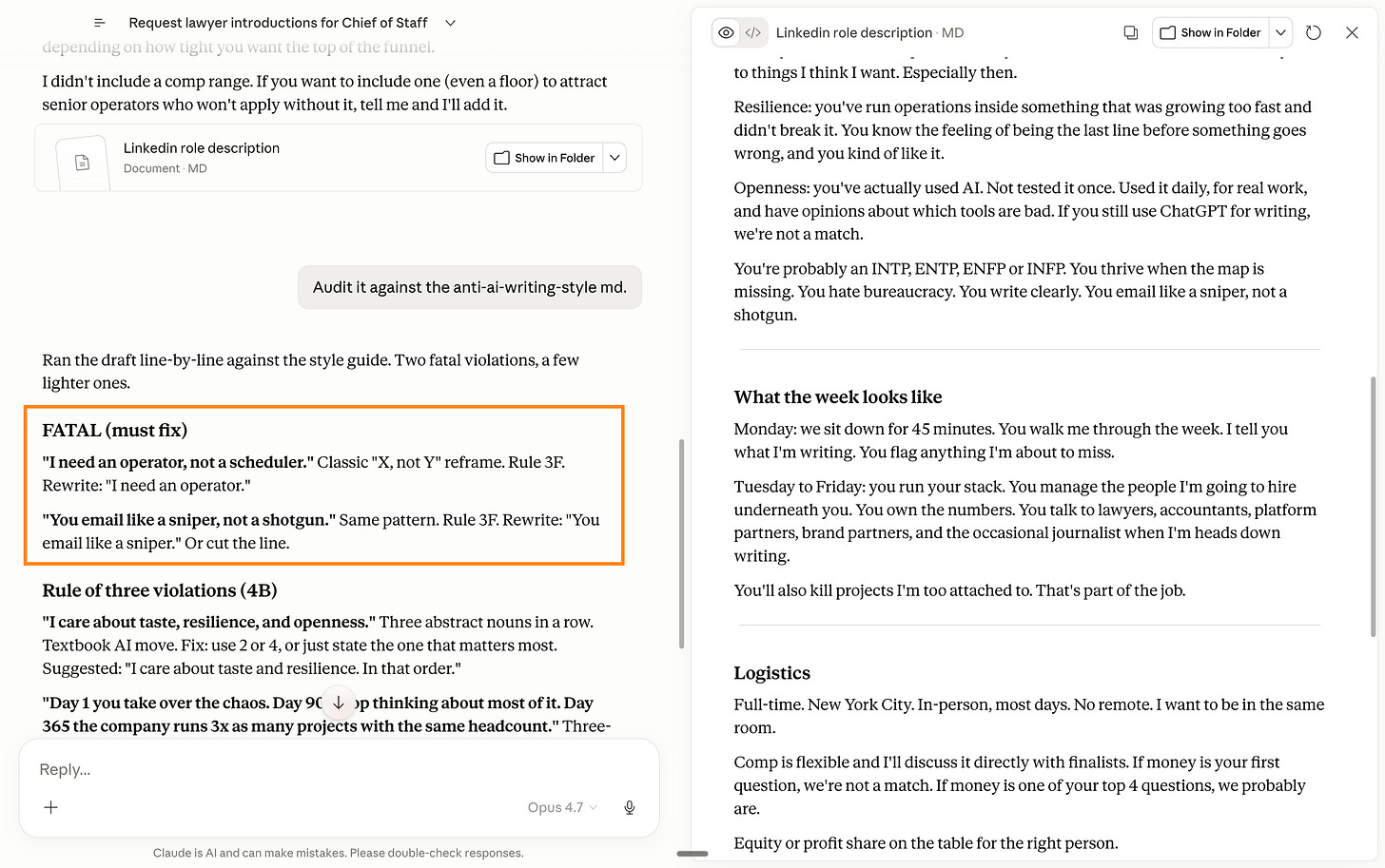
(Claude spots the formulaic writing and immediately fixes it)
Everything runs smoothly thanks to my Claude Cowork folder structure:
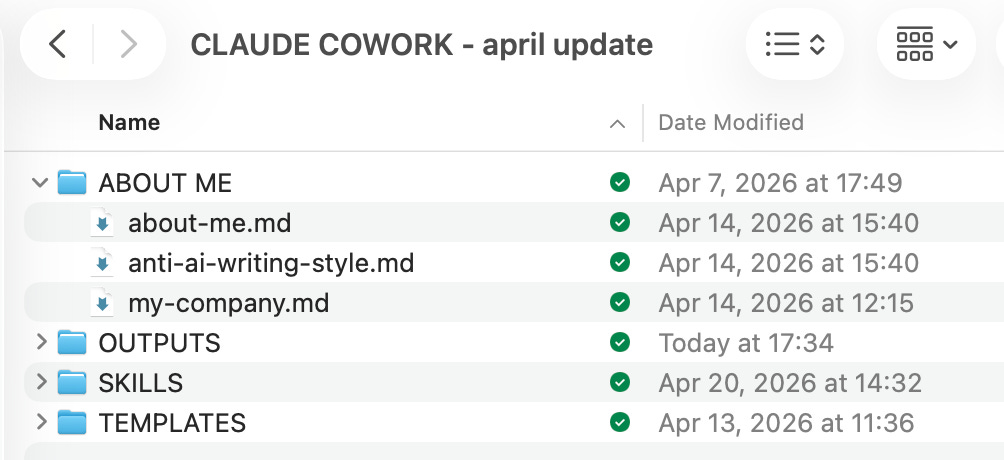
- about-me: Who I am, and what kinds of writing I like and dislike.
- my-company: My company’s vision, mission, and current situation.
- anti-ai-writing-style: The core file this article is about.
2. Upload it to Cowork in 3 steps
Here’s how to download the anti-ai-writing-style file and add it to your workflow:
1 - Download the file here
2 - Upload it to your Cowork folder.
3 - Quick tip: You can use Obsidian (completely free) to manage these files. When you edit a file in Obsidian, it automatically syncs to the folder on your computer, so Claude will always have access to the latest version.
4 - Update the “Global Instructions” (System-wide instructions) in Claude. Paste this in:
*“I usually start a session by pointing you to my Cowork folder. Before any task, you MUST read every file in the ABOUT ME/ folder:
- about-me: Information about me, my likes and dislikes.
- anti-ai-writing-style: I hate Claude’s default writing style. Unless you write and automatically check and audit the text against this anti-ai-writing-style file.
- my-company: Where I work and my role.
Never read the OUTPUTS/ or TEMPLATES/ folders on your own unless I explicitly point you to them. Save all deliverables to OUTPUTS/ in a subfolder named after the project. If the brief is unclear, use AskUserQuestion (ask the user for clarification). Don’t give long-winded explanations. Do the work and deliver the results.”*
3. What’s inside the anti-ai-writing-style file?
This file completely replaces all those ineffective “don’t write like AI” instructions you usually use. It contains:
- Banned sentence patterns: Negative parallelism and 15 of its ridiculous variations.
- Banned vocabulary (Vietnamese AI Blacklist): More than 100 words and phrases that AI heavily overuses (e.g., delve into, vibrant tapestry, unlock potential, leverage, realm/aspect, a clear testament…).
- Rhythm rules: Short paragraphs, a mix of long and short sentences, and no overuse of dashes or bullet points.
- Guidelines against “overdoing it”: To stop AI from writing empty clichés or mechanically trying to sound “human.”
A sample of what’s inside (abridged):
# WRITING RULES Goal: Write with context, taste, and a good reason to speak. Priority rules: 1. Accuracy -> 2. Clarity -> 3. Specificity -> 4. A human voice.
Default voice: Write directly, specifically, and naturally. Start immediately with a useful answer. Keep paragraphs short (1-2 sentences). Vary sentence rhythm. Use everyday workplace language and avoid grandiose wording.
Strictly prohibited: Negative parallelism. Don’t negate one perspective to replace it with another merely to create a false sense of depth.
- Do not use: “This isn’t X, it’s Y”, “Not only X, but also Y”, “Forget X, focus on Y”.
Metaphor control: Do NOT use metaphors by default. Use them only when the subject is too abstract and a metaphor helps readers understand it faster. Strictly prohibit clichéd metaphors such as: “journey”, “battlefield”, “ecosystem”, “compass/guiding light”, “genetic code/DNA”…
4. You don’t need overly complicated prompts
This single prompt is enough to handle 80% of the work: “I want to [DO THIS TASK] to [ACHIEVE THIS GOAL/MEET THESE CRITERIA].”
If you don’t have a clear direction yet, add: “Ask me questions before you begin so we can agree on the plan first.”
And once Claude has finished responding, if you’re not satisfied, simply type: “Please review and revise this text, following every rule in the anti-ai-writing-style.md file closely.”
5. How to analyze and spot AI writing in the real world
Below are 3 real-world examples taken from reports by Fortune 500 giants. Let’s “dissect” them to see why one glance is enough to tell they were written by AI:
Example 1 (Cisco):
“In 2026, AI will not just be a tool; it will be a partner.”
- What’s wrong here? Basic negative parallelism.
- Why is it bad? Machines love this trick: deliberately downplaying one thing (a tool) to elevate another (a partner), trying to sound profound and “philosophical.”
- A real person would write: “In 2026, AI has officially become a valuable partner.” (Short, direct, without roundabout negation).
Example 2 (Accenture):
“The future of autonomous technology isn’t just on the horizon; it’s unfolding right now.”
- What’s wrong here? Negative parallelism + an empty metaphor.
- Why is it bad? Business/technology writing doesn’t need overly sentimental phrases like “on the horizon” or “unfolding.” It feels more like a formulaic high-school literature essay than a professional report.
- A real person would write: “Autonomous technology is no longer a distant prospect; it is ready for practical use.”
Example 3 (McKinsey):
“These systems aren’t just executing tasks; they are beginning to learn, adapt, and collaborate.”
- What’s wrong here? The “not just/but also” combo + AI’s sacred rule of three.
- Why is it bad? The sentence rhythm is so perfect that it feels artificial. Whenever AI runs out of ideas, it automatically churns out 3 verbs (learn, adapt, collaborate) or 3 adjectives (fast, safe, efficient) in a row. Repeating this formula is a 100% giveaway that a machine wrote it.
- A real person would write: “This system can now learn on its own and work with others instead of passively waiting for instructions.”
Other common “AI ailments” in Vietnamese writing:
- Inflated language (Puffery): It loves phrases such as “a major turning point”, “a seismic shift”, “a revolution”. Just state the facts and figures, and let readers judge their importance.
- Overusing participial phrases/connectors to stall: AI writing in Vietnamese especially loves opening clauses with: “Thereby emphasizing the importance…”, “Contributing to the tapestry…”, “Thus helping to open up…”. Delete them all. The writing can be a little choppy or rough around the edges, but at least it’s human.
- Avoiding the word “IS”: AI always likes to dress things up with phrases such as: “serves as”, “represents”, “is regarded as a testament”. Just use “is” to keep it simple and strong.
6. Keep this file updated
AI writing styles are constantly changing and evolving. Words that sounded normal in 2024 already sound very dated and “distinctly robotic” by 2026.
Treat anti-ai-writing-style.md as a living document. Every 3 months, reread your AI-written drafts, circle the words and sentence patterns that feel robotic and artificial, and throw them straight onto the banned list.
Ultimately, taste for a content creator really comes down to saying “no” to 99% of what AI produces, and keeping only the 1% that sounds most like your own voice.
Related articles
Read more on XuanHieu.org
Bài liên quan
- "Conversation with Thanh" Nguyễn Thành Nam: When the essence of liberation slips into the frivolity of history
- Download Comet Perplexity AI Browser (Latest 2026): Official Links & How to Get an Invite Code Instantly
- Khao Man Gai: Secrets to Authentic Thai Flavor at Home!
- Thai-Style Steamed Fish with Lime and Garlic: Delicious, Healthy, and Easy to Make at Home!
- Khao Man Gai: A Journey to Discover Thailand’s Famous Chicken Rice!
- Cafe Amazon Bangkok 2026: Latest Menu & Prices!
- Pad Thai Fai Ta Lu: Bangkok's Rising Michelin Pad Thai Spot—A Worthy Rival to Thipsamai?
- Master KLING AI 1.6 with a 4000-Line Guide and Master Video Prompt Creation GPT







Bài liên quan
- "Conversation with Thanh" Nguyễn Thành Nam: When the essence of liberation slips into the frivolity of history
- Download Comet Perplexity AI Browser (Latest 2026): Official Links & How to Get an Invite Code Instantly
- Khao Man Gai: Secrets to Authentic Thai Flavor at Home!
- Thai-Style Steamed Fish with Lime and Garlic: Delicious, Healthy, and Easy to Make at Home!
- Khao Man Gai: A Journey to Discover Thailand’s Famous Chicken Rice!
- Cafe Amazon Bangkok 2026: Latest Menu & Prices!
- Pad Thai Fai Ta Lu: Bangkok's Rising Michelin Pad Thai Spot—A Worthy Rival to Thipsamai?
- Master KLING AI 1.6 with a 4000-Line Guide and Master Video Prompt Creation GPT