



Okay, fellow Thai food lovers, are you ready? Raise your hand if you’re a die-hard fan of Thai cuisine! Today, your blogger gal is taking you on a little expedition to uncover a street-food superstar whose name alone is enough to get your stomach rumbling: Khao Man Gai! By the end of this post, you’ll not only know this famous chicken rice dish inside out, but you’ll also be able to make a version that’s just as delicious as the ones served at restaurants. Get your pen and paper ready—actually, scratch that, just get ready to drool!
Key Takeaways
- Khao Man Gai is Thailand’s version of Hainanese chicken rice (cơm gà Hải Nam), with its own distinctive flavor.
- This dish has a long history dating back to the Ayutthaya period and is an icon of Thai street food.
- An authentic plate of Khao Man Gai depends on tender, juicy poached chicken, wonderfully fragrant rice cooked with chicken fat and stock, and a flavorful dipping sauce.
- You can make Khao Man Gai at home using the detailed recipe shared here.
- Pratunam in Bangkok is one of the best-known places to enjoy delicious Khao Man Gai.
# Khao Man Gai: Secrets to Authentic Thai Flavor at Home!
Khao Man Gai: What Makes Thailand’s Version of “Hainanese Chicken Rice” So Unforgettable?
The name Khao Man Gai (ข้าวมันไก่), pronounced roughly “khow-man-guy,” might sound familiar to some of you—rather like our much-loved Hainanese chicken rice, right? Exactly! Khao Man Gai is the Thai version of Hainanese chicken rice, but naturally, it has been given a Thai twist, creating a flavor so distinctive that one taste is enough to have you hopelessly hooked.

Its family tree is pretty impressive, too. From what I’ve researched and heard from longtime food vendors in Bangkok, Khao Man Gai dates back to the Ayutthaya period, around the 17th century. At first, it was a simple, home-style meal of poached chicken and white rice for working people. But good food speaks for itself, and this simple yet incredibly delicious dish gradually won people over, spread throughout Thailand, and became one of the icons of Thai street food that every visitor should try. By the 19th century, eateries had begun introducing variations with pork, shrimp, mushrooms, and more, but poached chicken with rice cooked in chicken stock remains the timeless favorite.
What makes Khao Man Gai special isn’t just its flavor, but also the unmistakably Thai street-side atmosphere in which you enjoy it. Imagine sitting at a roadside eatery, surrounded by traffic sounds and lively conversations, with the aromas of chicken, rice, and dipping sauce mingling in the air… Oh, everyone, it’s a whole cultural experience! This isn’t just about filling your stomach; it’s about getting a taste of the rhythm of life in Bangkok, Chiang Mai, or anywhere else in Thailand.
Breaking Down an Authentic Plate of Khao Man Gai: It’s Not Just Chicken and Rice!
An authentic Thai plate of Khao Man Gai takes more than simply putting chicken and rice together. Every component has its own role to play in creating the perfect whole. Having spent plenty of time eating my way around Thailand and trying countless places, from sidewalk stalls to restaurants, allow me to break it all down for you:
Sensational poached chicken: Tender and juicy, with glossy skin
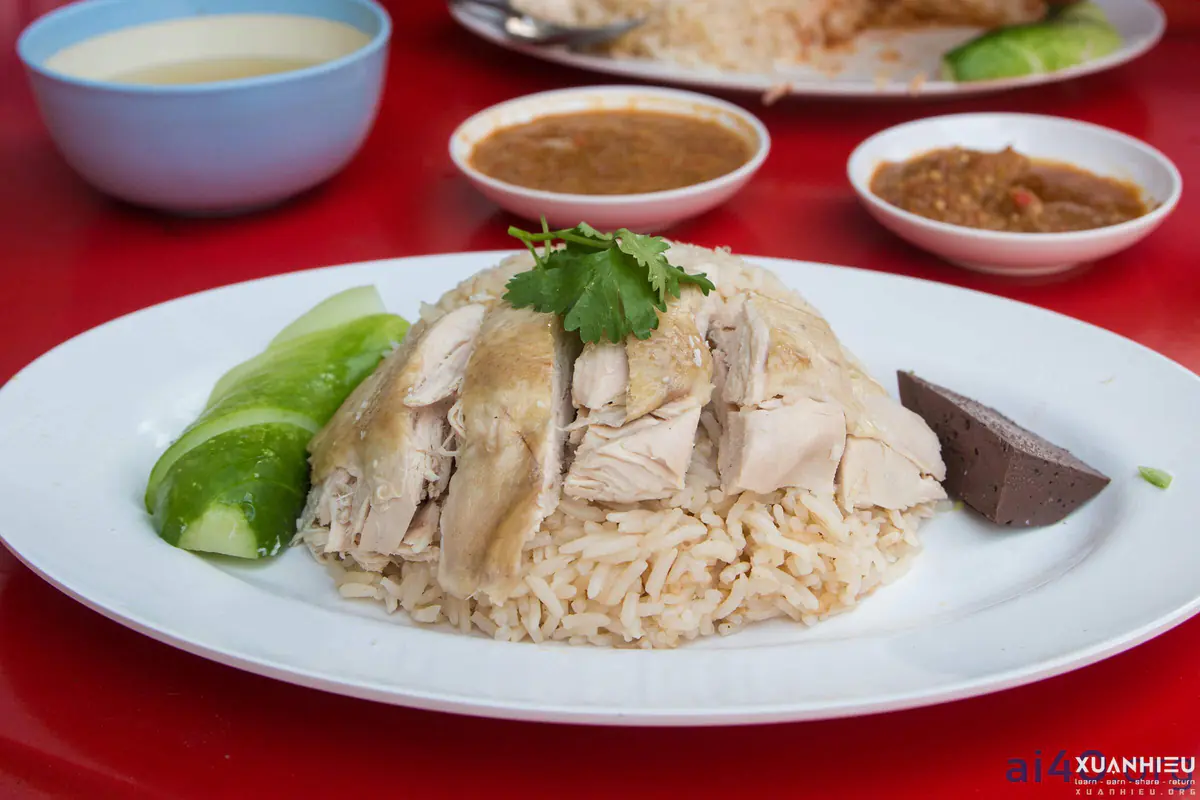
This is the first star of the show. Khao Man Gai is usually made with a free-range chicken, poached whole using a special technique that cooks the meat just through, leaving it tender and naturally sweet rather than dry and crumbly, with taut, glossy skin that’s naturally golden—not yellow from food coloring. I’ve noticed that the really good places plunge their freshly poached chicken straight into ice water to give the skin a firmer bite and firm up the meat. The chicken is chopped into bite-sized pieces and arranged neatly over the rice.
Wonderfully fragrant rice: The secret is chicken fat!
This is the second ace up the dish’s sleeve, and in my opinion, it accounts for 80% of how delicious it tastes. Fragrant, tender, long-grain Thai Jasmine rice is the top choice. But what truly makes the difference is that the rice is cooked in chicken stock and, most importantly, with fragrant rendered chicken fat. Before cooking, the rice is briefly toasted with garlic, ginger, and chicken fat. This “top-secret” step produces fluffy, glossy grains infused with the delicate sweetness of chicken stock and that distinctive richness. Just smelling the rice is enough to make you crave it! This is the beloved secret that not everyone will let you in on!

“Nam prik khao man gai” dipping sauce: The soul of the dish
If the chicken and rice are the body, the dipping sauce is the soul of Khao Man Gai. This heavenly little bowl of sauce is called Nam Prik Khao Man Gai (น้ำพริกข้าวมันไก่). It’s a wonderful blend of fermented soybean paste (taochiao), minced ginger, minced garlic, green and red bird’s eye chilies (go all out if you can handle the heat), vinegar, sugar, and a little soy sauce. The flavor is nothing short of explosive: a harmonious balance of salty, sweet, sour, and spicy, with the warming kick of ginger and garlic. Each eatery has its own secret dipping sauce recipe, giving it a distinctive signature. I absolutely adore this sauce; eating chicken rice without it is like missing out on half the joy.
The essential accompaniments: Don’t overlook the little details!
A complete plate of Khao Man Gai needs a few thin slices of cucumber to cut through the richness and a little cilantro (coriander) for fragrance. In particular, it usually comes with a small bowl of soup. This is typically clear chicken broth with a few slices of winter melon or tender, simmered daikon, lightly seasoned to balance the flavors. Some fancier places even add a few pieces of luat gai (เลือดไก่), or boiled chicken blood curd.
Handy Secrets for Making Restaurant-Quality Khao Man Gai at Home
Going to Thailand to eat Khao Man Gai is hard to beat, but we can’t always pack our bags and head off, right? So why not try bringing Thailand home by making it yourself? Drawing on an authentic recipe I picked up and my own kitchen experience, here’s the recipe for everyone to try. Don’t worry—it’s not too difficult; all you need is a little care and a love of Thai food!
Quality ingredients make a standout dish:
- Chicken: 1 whole free-range chicken (about 1-1.2kg) or 500g chicken thighs (if you love thighs like I do, go for it)
- Rice: 2 cups Thai Jasmine rice
- Seasonings for poaching the chicken: A few slices of ginger, 2-3 crushed shallots, 1 teaspoon salt, 1 teaspoon stock granules (optional).
- Ingredients for the rice:
- 2-3 garlic cloves, minced
- 1 small piece of ginger, finely minced
- 1-2 tablespoons chicken fat (taken from the chicken or bought separately; you can substitute cooking oil, but it won’t be as fragrant)
- Chicken stock (enough to cook the rice)
- Ingredients for the heavenly dipping sauce:
- 2 tablespoons fermented soybean paste (taochiao—you can find this at Thai grocery stores or buy it online)
- 1 tablespoon light soy sauce
- 1 tablespoon rice vinegar
- 1 tablespoon sugar
- 1 teaspoon dark soy sauce (for a lovely color, optional)
- 1-2 teaspoons finely minced ginger
- 1-2 teaspoons finely minced garlic
- Green/red bird’s eye chilies, finely chopped (to suit your heat tolerance)
- A little lime juice (optional, if you prefer a brighter tang)
- Accompaniments: Cucumber, cilantro, winter melon soup (made with the remaining chicken stock).
Let’s get cooking!
Step 1: Prepare the chicken—the key to tender, flavorful meat
Clean the chicken and rub it with salt to remove any unwanted odors. If there are any pieces of chicken fat, remove and set them aside to render later for the rice. Place the chicken in a pot, add enough water to cover it, then add crushed ginger, shallots, salt, and stock granules. Poach over medium heat; once the water boils, turn the heat down and skim off the foam regularly to keep the stock clear. My little trick is to let the chicken simmer very gently for about 20-25 minutes (depending on its size), then turn off the heat, cover the pot, and leave it to soak for another 15-20 minutes so the meat cooks gently all the way through without drying out. Lift the chicken out and immediately immerse it in a bowl of ice water for about 10 minutes to firm up the skin and meat. Then remove it and let it drain. Reserve the poaching stock for the rice and soup.
Step 2: Cook the rice in chicken stock—here’s the magic!
Rinse the rice and drain it. Place a pan on the stove and render the chicken fat (or use cooking oil if you don’t have any). Sauté the minced garlic and ginger in a little chicken fat (or cooking oil) until fragrant, then add the rice and toast briefly for about 2-3 minutes, until the grains firm up and absorb the flavors.
Transfer the toasted rice to a rice cooker and add the chicken stock (use the same amount of liquid you normally would for cooking rice). Press the cook button. Rice cooked in chicken stock and chicken fat is wonderfully fragrant and rich, with beautiful glossy grains—you’ll be hooked after one bite!
Step 3: Mix the dipping sauce—irresistibly flavorful
While waiting for the rice and chicken, I use the time to make the dipping sauce. Put all the sauce ingredients (fermented soybean paste, soy sauce, vinegar, sugar, dark soy sauce, ginger, garlic, and chopped chilies) into a bowl and stir until the sugar dissolves completely. Taste and adjust to suit your family’s preferences. If you like a bright, refreshing tang, add a little lime juice. Without this little bowl of sauce, Khao Man Gai loses half its appeal.

Step 4: Plate up and enjoy!
Once the chicken has cooled a little, chop it into bite-sized pieces. Spoon the cooked rice onto a plate. Arrange the chicken on top, then add a little cilantro and a few slices of cucumber. Ladle out a bowl of winter melon soup made with the chicken stock. And of course, don’t forget that heavenly dipping sauce on the side.
That’s it! A wonderfully fragrant, authentically Thai plate of homemade Khao Man Gai is ready. There’s something so satisfying about making a dish you love with your own hands, everyone.
Hunting Down Famous Khao Man Gai in Thailand: My Hard-Earned Tips
Even though you can make it at home, if you get the chance to travel to Thailand, you absolutely must try the original version of Khao Man Gai. Every region and every eatery has its own interesting little differences.
In my experience, Pratunam in Bangkok is a Khao Man Gai paradise. The most famous places are probably the two eateries facing each other: the “pink-shirt” spot (Go Ang Pratunam Chicken Rice, which has even earned a Michelin Bib Gourmand) and the “green-shirt” spot (Kuang Heng Pratunam Chicken Rice). Both are packed with customers, especially tourists. I’ve tried both, and each is wonderful in its own way. A little tip: go early or avoid peak hours so you don’t have to queue for too long.
In Chiang Mai and other cities, don’t hesitate to try sidewalk stalls and night markets; if a place is full of locals eating, chances are it serves delicious food at a good price. Don’t be shy about asking “Khao Man Gai?” and pointing—Thai people are very friendly! A plate of Khao Man Gai is usually very affordable, costing only around 40-60 Baht (about VND 30-45 thousand). Fantastic value for a filling, satisfying meal!
Conclusion: Khao Man Gai—More Than a Dish, It’s a Piece of Culture!
And there we have it: we’ve explored Khao Man Gai inside out. From its history and ingredients to making it at home and finding must-try places in Thailand, I hope my tips have given you another delicious dish to add to your Thai food checklist. To me, Khao Man Gai isn’t just a filling meal; it’s part of the pulse of Thailand’s streets, a cultural experience you shouldn’t miss.
Don’t hesitate to try the recipe I’ve shared—who knows, you might discover your own ultimate version of Khao Man Gai! And if you get the chance to visit Thailand, remember to head straight to a Khao Man Gai stall to experience its authentic Thai flavors in full. Wishing you all some truly wow-worthy food adventures, and I’ll see you in my next posts exploring Thailand! For now, though, someone please bring me a plate of Khao Man Gai—writing this has made me so hungry!
Related Articles
Bài liên quan
- Thai-Style Steamed Fish with Lime and Garlic: Delicious, Healthy, and Easy to Make at Home!
- Khao Man Gai: A Journey to Discover Thailand’s Famous Chicken Rice!
- Cafe Amazon Bangkok 2026: Latest Menu & Prices!
- Pad Thai Fai Ta Lu: Bangkok's Rising Michelin Pad Thai Spot—A Worthy Rival to Thipsamai?
- "Conversation with Thanh" Nguyễn Thành Nam: When the essence of liberation slips into the frivolity of history
- Bypass AI content: make AI writing sound more natural
- Download Comet Perplexity AI Browser (Latest 2026): Official Links & How to Get an Invite Code Instantly
- Master KLING AI 1.6 with a 4000-Line Guide and Master Video Prompt Creation GPT





Bài liên quan
- Thai-Style Steamed Fish with Lime and Garlic: Delicious, Healthy, and Easy to Make at Home!
- Khao Man Gai: A Journey to Discover Thailand’s Famous Chicken Rice!
- Cafe Amazon Bangkok 2026: Latest Menu & Prices!
- Pad Thai Fai Ta Lu: Bangkok's Rising Michelin Pad Thai Spot—A Worthy Rival to Thipsamai?
- "Conversation with Thanh" Nguyễn Thành Nam: When the essence of liberation slips into the frivolity of history
- Bypass AI content: make AI writing sound more natural
- Download Comet Perplexity AI Browser (Latest 2026): Official Links & How to Get an Invite Code Instantly
- Master KLING AI 1.6 with a 4000-Line Guide and Master Video Prompt Creation GPT