

Tóm tắt nhanh
Claude Fable 5.2 landed on November 9, and my timeline immediately started picking sides. I used to do that too. This is not a Fable review. I hired Viktor,…
- 1. The numbers first: The public lines are from Viktor’s own pages.
- 2. The week a new model drops: Fable 5.2 is a real release. Anthropic published it on November 9, 2026, and positioned it for the most ambitious, open-ended technical work.
- 3. One mode for the whole team: The mistake I kept making was treating every new model as a new setup.
- 4. When I still pick a model myself: I did not cancel everything. I still pay $100 a month for Grok, because some of my work still lives there.
- 5. The three jobs I actually handed over: I run a marketing agency I started on X, plus the content routine around it: briefs, articles, weekly recaps, the basic work that used to eat the middle of the day.

Claude Fable 5.2 landed on November 9, and my timeline immediately started picking sides. I used to do that too.
This is not a Fable review. I hired Viktor, the AI employee 70,000+ teams have already hired, and I stopped rebuilding my stack every time a new model ships.
I cancelled a $30 Claude subscription and kept my $100 Grok plan. Viktor is the hire who sits in Slack, runs the content routine, and waits for my yes. I set one mode for the team, I pick a specific model only where it matters, and I can ask him where the credits are going when I want a checkup.
This is for founders and small teams that live in Slack or Microsoft Teams, and for anyone running a marketing shop or a content routine who is tired of paying for one more model. Inside: how Viktor’s modes work, when I still choose a model myself, the three jobs I handed him in the agency, and the bill I can actually show.
This week the name on the timeline is Fable. Next week it will be a different one. I am using the drop as the door into this piece, not as the subject of it. The subject is Viktor, and why I stopped treating every launch as a reason to rebuild the stack.
1. The numbers first
Viktor, public facts
teams that have hired him       70,000+
tools he connects to            9,800+
where he lives                  Slack and Microsoft Teams
annualized revenue run rate     $50M, about seven months after launch
actions that matter             wait for a human yes

modes for the whole team
Ultra                           the hardest work
Smart                           everyday work, the default
Balanced                        routine, high-volume work
Cheap                           quick lookups and checks

my bill, the part I can show
Grok, still paying              $100 a month
Claude, cancelled               $30 a month
those two, before               $130 a month
direct saving I can show        $30 a month

three agency jobs, by my math
one client brief                about 45 minutes by hand
                                about 12 minutes with Viktor
research and outline, one article
                                about 2 hours by hand
                                about 35 minutes with Viktor
weekly content recap            about 50 minutes by hand
                                about 15 minutes with Viktor
The public lines are from Viktor’s own pages. The revenue line is the figure he allows us to use: annualized revenue run rate, about seven months after launch. The subscription lines are mine. The three job times are by my math, from the marketing agency I run on X and the content work that sits around it. I have not posted a Viktor credit-spend figure I cannot open on the Usage page.
2. The week a new model drops
Fable 5.2 is a real release. Anthropic published it on November 9, 2026, and positioned it for the most ambitious, open-ended technical work. That is enough to start an argument on X. It is not enough of a reason to rebuild a team.
Anthropic’s own launch post says Fable is best for that harder technical work, and that most coding and knowledge tasks should still start on their everyday model. Even the lab that shipped the new model is telling you not to move everything onto it.
That is the part I wanted to write about. The feed will argue about the new model this week and about the next one the week after. Viktor is the hire that stays in place while the list changes.
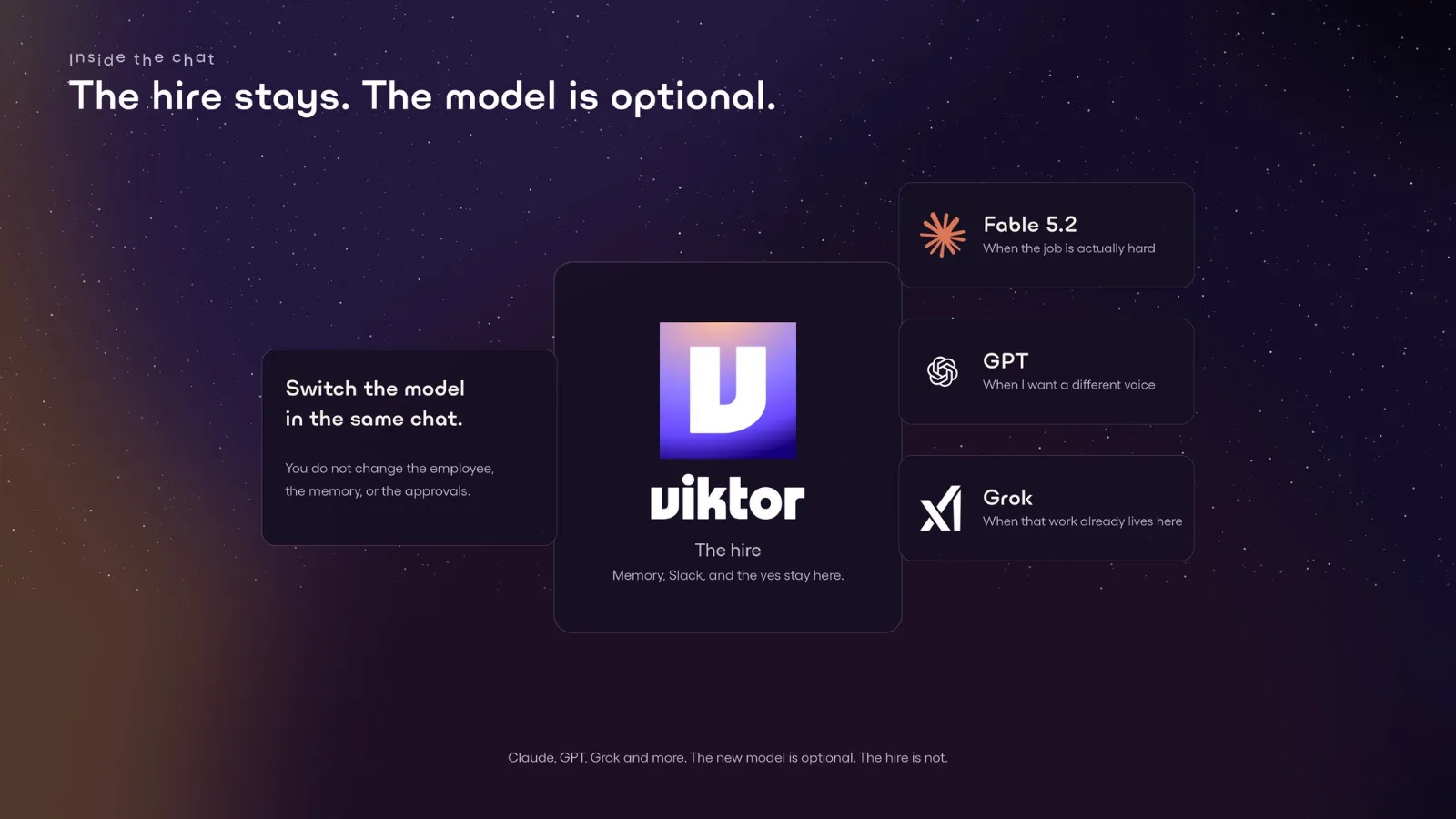
The usual move, for me, was a new tab and a new bill. I would paste the same brief into a fresh box, then wonder why the work felt like it was starting over. Viktor keeps the job in the chat that already has the context. If a task is ambitious, open-ended technical work, I can switch the model for that job. I do not have to hire a new employee, move the memory, or change the approval to do it.
I can switch a model inside a chat when a job actually needs it. I do not have to change the employee, the memory, or the approvals to do it. The new model is optional. The hire is not.
Introducing Claude Fable 5.2 and Claude Mythos 5.2, designed to tackle the most daunting technical challenges.
They’re capable collaborators on ambitious projects in many fields, and show improvements in areas like coding, reasoning, and vision.
— Claude (@claudeai) · 2026-11-09

3. One mode for the whole team
The mistake I kept making was treating every new model as a new setup. A new tab, a new bill, a new place to paste the same brief.
Viktor works the other way. I set one mode for the whole team, then I only touch the model picker when the job is special.
- Smart is the default, and it is where everyday work should live.
- Ultra is for the hardest jobs, when I actually need more depth.
- Balanced is for routine, high-volume work.
- Cheap is for quick lookups and checks, the tasks that should not burn a top model.
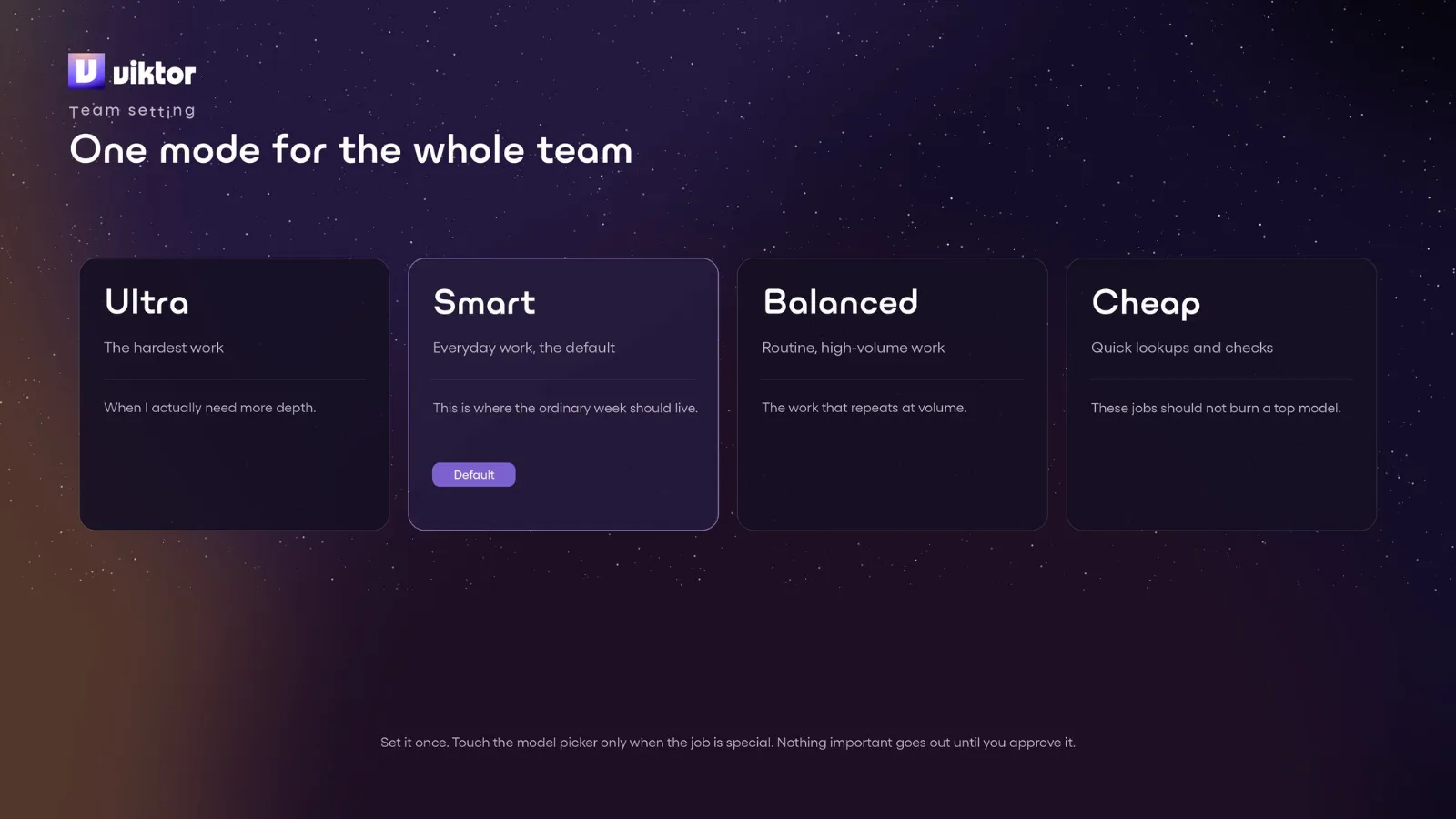
That list is from Viktor’s own product, not from a benchmark chart. I use it as a team setting, not as a weekly personality test.
I set Smart and I leave it there for the ordinary week. I only move a job to Ultra when the work is actually hard, and I only drop a job to Cheap when it is a lookup. The week a model drops is a bad week to retune all of that, because the feed makes every task look special. The mode is a team setting. It should still be there after the launch post has left the timeline.
If a scheduled job should run on a cheaper setup, Viktor can give that job its own model. A daily check does not need the same setup as a weekly report. He lets me set that per automation, and nothing important goes out until I approve it.
On the fly I can type !fast when I want a quick answer, or !deep when the problem is hard. That is a turn-level choice, not a reason to open another subscription.
Those two commands are for a single turn. They do not change the team mode, and they do not open a new account. That is the difference I wanted: a way to go faster or deeper inside the hire I already have.
Viktor also connects to 9,800+ tools and lives in Slack and Microsoft Teams, which is where the team already talks. I do not have to move the work into a new product every time a lab ships a new name. The job can stay in the same place, and Viktor can still wait for my yes before anything important leaves.
4. When I still pick a model myself
I did not cancel everything. I still pay $100 a month for Grok, because some of my work still lives there. I cancelled that $30 plan, because the bill was the extra model habit: another place to send the same routine.
I still choose a model myself when the job is specific. A hard research pass. A draft I want in a particular voice. A check I want to run cheap. Viktor does not pick the best or the cheapest model for each task by himself. That is not how he works, and I will not write it as if he does.
What he does is keep the job in one place. I can switch models inside a chat, Claude, GPT, Grok and more, and the work stays with him. The memory stays. The approval stays. I am not starting from a blank box every time a lab ships a new name.
The honest line is this: I still pick a model when I have a reason. I stopped picking one every time the timeline told me to.
That is also why I still have a Grok bill and no longer have the extra Claude bill. Some work still belongs in the place I already paid for. The part I cut was the habit of opening a second home for the same routine. Viktor is the home for that routine now. The model inside a given chat can change. The hire does not.
5. The three jobs I actually handed over
I run a marketing agency I started on X, plus the content routine around it: briefs, articles, weekly recaps, the basic work that used to eat the middle of the day.
I am not going to pretend I timed every minute with a stopwatch. These three jobs are by my math, from work I actually do.
One client brief. By hand, a proper breakdown took me about 45 minutes: the offer, the constraints, the claims I can and cannot make, the first outline for the piece. With Viktor, I hand him the brief and the rules, he drafts the breakdown, and I edit. That is about 12 minutes of my time, and he waits for my yes before anything leaves. The useful part is not only the shorter pass. It is that the constraints stay with him, so the next brief does not start from a blank page.
Research and outline for one article. By hand, about 2 hours: sources, structure, what has to be in the piece, what is just noise. With Viktor, about 35 minutes. I still check every claim, and I still open a source myself when a line has to stand up. He does not publish it for me. The time I get back is the first pass and the structure, not the final responsibility.
The weekly content recap. By hand, about 50 minutes to pull what ran, what can be reused, and what needs a decision. With Viktor, about 15 minutes, then I review the recap and approve it. If I skip that review, it is not a hire anymore. It is just another draft leaving without me.
None of these jobs required a new model the week the release dropped. They required Viktor, a hire who already knew the routine, and a yes from me at the end. I am writing about these three because they are the jobs I can describe from my own week. Viktor can also build apps, dashboards, and pages. I am not using those as my examples here, because I wanted to stay with work I actually handed him.
6. The bill I can show
Here is the money I can put on screen without guessing, next to the work I already gave Viktor.
I was paying $130 a month across two subscriptions: $100 for Grok and $30 for Claude. I cancelled Claude. That is $30 a month I can show, $360 a year if the price stays the same. I still pay $100 for Grok.
I have not cancelled Grok, and I will not write a bigger savings number I cannot open in a billing page. Viktor also has a Usage page, credits per task and per person, and a monthly cap on each automation. I can ask him, “Where are my credits going?” He reads his own usage, names the most expensive jobs, and proposes fixes: a cheaper model where top quality is not needed, fewer runs, running only when there is new data, pausing what nobody uses. Nothing changes until I approve it.
He can also offer, without being asked, to turn the fixed steps of an automation into a script that runs without the model. The model only handles the parts that need judgment, so each run uses far less reasoning. Chat-based AI tools don’t do this.
I am not going to invent a credit total for this article. If I cannot open it on the Usage page, it does not go in. The saving I can stand behind today is the cancelled Claude bill, and the time back on those three jobs.
Viktor can also run a regular health checkup of the workspace, skills, automations and spend, with suggested savings and one-click actions. Again, nothing changes until I say yes.
A checkup is not a score, and it is not a promise that the bill will fall by a number I have not seen. Viktor looks at the workspace, names what is expensive or unused, and suggests what to cut, pause, or turn into a script. I treat that the same way I treat a draft: I read it, I keep what I agree with, and I leave the rest. One-click actions are useful only if I am the one clicking them.
7. A test you can run this week
If you want to see whether this is a real hire or just another tab, run a week like this.
Mon   set the team mode to Smart
      pick Ultra for one hard job only
Tue   hand him one recurring brief or report
      edit it, do not let it leave without your yes
Wed   give one scheduled job its own cheaper setup
Thu   ask: where are my credits going?
      approve only the fixes you can live with
Fri   keep one job where you still pick the model
      write down why
Do this in Slack or Microsoft Teams, where Viktor already lives. You do not need a new workspace just to run a one-week test.
Then look at one bill you can show: a cancelled subscription, a Usage line, or a job you timed twice. If you cannot show it, do not post it. At the end of the week you should have one of those three things in your hand. If you have none of them, the test was just another tab.
8. What I checked and what I didn’t
I read the Fable 5.2 announcement, and I used Viktor’s published product facts: the modes, the model switch, the Usage page, the checkup, and the script offer.
The subscription numbers are mine: $100 for Grok, $30 for the plan I cancelled. The three job times are by my math.
I have not posted a Viktor credit-spend figure in this article. I have not audited his internals. I have not measured your costs. They depend on the work you give Viktor and the mode you set.
I am not telling you that you will save $30 a month, or that your brief will drop to 12 minutes. Those are my figures. Yours will be different.
The point
A new model will ship again. The argument on the timeline will start again.
I stopped treating that argument as a reason to open another bill. I hired Viktor, set one mode for the team, and I pick a model only when the job needs it. The work I can already show is a cancelled $30 subscription and three agency jobs that now take a short review instead of a long stretch of my day.
That is what I mean by the title. I stopped picking a new model every time a lab ships a name. I kept Viktor, I set one mode, I pick a model only when the job needs it, and the bill I can show is the one I cut.
If you want one on your team, hire @viktor_com. Free to start.
Use code GIPP100 for $100 in free credits. The link is in the first reply.
Sources, as of November 11, 2026: Anthropic, Claude Fable 5.2 and Mythos 5.2, Viktor changelog, Viktor docs, setup guide. Public facts from Viktor’s own pages: 70,000+ teams, 9,800+ tools, and a $50M annualized revenue run rate about seven months after launch.
Customer stories, if you want the public receipts: Hampton, O8, TWL.
If you want more breakdowns like this, I post one every couple of days on Telegram and X. Both free.
X: https://x.com/gippp69 Telegram: https://t.me/GipArcAI Substack: https://substack.com/@gippp
#AIemployee
Paid Partnershipсттаь
Đọc thêm
Nguồn
Stop Picking Models and Spend Less with Viktor (Full Guide) của Gipp 🦅 (@gippp69), đăng ngày 2026-11-13.
Bài liên quan
- How to Turn Claude Code Into a Reverse Engineering Team with 7 Steps (full setup)
- How to build an agent team in Grok Bot with Opus 5.5 + GitHub (Lauren Tan's Method)
- Bypass AI content: viết nội dung AI tự nhiên hơn
- Shakker AI: Hướng Dẫn Tạo Ảnh Profile Bằng AI Chi Tiết
- MOKI: AI làm phim hoạt hình Siêu đỉnh của Meitu - App làm đẹp trứ danh
- Đột phá AI bí ẩn (Q*) trí tuệ nhân tạo tổng hợp (AGI)




Bài liên quan
- How to Turn Claude Code Into a Reverse Engineering Team with 7 Steps (full setup)
- How to build an agent team in Grok Bot with Opus 5.5 + GitHub (Lauren Tan's Method)
- Bypass AI content: viết nội dung AI tự nhiên hơn
- Shakker AI: Hướng Dẫn Tạo Ảnh Profile Bằng AI Chi Tiết
- MOKI: AI làm phim hoạt hình Siêu đỉnh của Meitu - App làm đẹp trứ danh
- Đột phá AI bí ẩn (Q*) trí tuệ nhân tạo tổng hợp (AGI)